Any gardener who knows the herculean effort needed to keep aggressive weeds from choking out their dainty heirloom lettuces has at some point asked “why don’t I just eat these instead?”
It turns out that you can, at least sometimes.
For three years, we farmed a little plot of land about an hour outside of Beijing. Rented from a local organic farm, that ten square meters of nature was a lifesaver, especially during the worst of Covid-19 when there was quite literally nowhere else to go.
Besides the vegetables, the sunshine, and the chance to commune with talkative farm animals, spending time at the farm gave me a chance to see the agrarian cycle up close.
Being from Indiana, I do know a farm when I see one. Like all Hoosiers, I bleed high fructose corn syrup (don’t worry, I’m seeing a doctor for that), and like many of my grade school classmates, I spent a summer of my childhood getting paid well below minimum wage to pull the tassels off of corn for some damn reason.
But that’s not farming, it’s industrialized corporate agriculture, corn monoculture being among the worst offenders.
Farming is something quite different. Assuming that your goal is to stay on the land, rather than to flip it after a couple of years, you find ways to maintain the fertility of the soil, rotating crop fields with a season of nitrogen-fixing clover or grazing and adding organic fertilizer. Chinese farmers have known for millennia that the reason to raise pigs is less for the meat than the manure. In Tokugawa Japan, human waste carted in from the cities to spread on rice fields was so valuable that poop theft became a significant problem.
Farming also means knowing that sometimes weeds aren’t weeds. Once your main crops come up, the appearance of a few dandelions hurts precisely nobody. And assuming Montsanto hasn’t been spraying around your backyard, those dandelion greens aren’t just edible, they’re delicious.
Which brings us to xian 苋.
Xian (amaranthus) is a leafy little plant that grows into a leafy big plant — about waist high at maturity. It springs like magic from freshly-turned soil and should you be of such a mind, you can drive yourself blissfully mad plucking out the tiny sprouts as fast as they pop up.
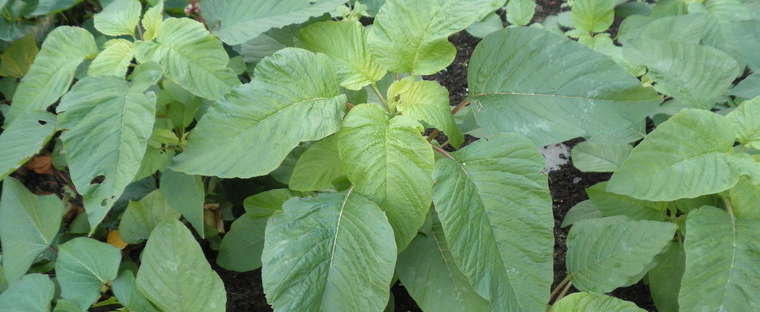
Chinese agronomists have known about xian for centuries. Xian appears in a 13th-century farm manual1 not as one plant, but as a whole family that includes purple and red varieties (including the one known in English as “red spinach”), as well as the tiny, ground-hugging plant called “horse-tooth” xian 马齿苋, none other than purslane.
The whole xian family has medicinal value. The same 13th-century farm manual quotes a much older ancient text Zhouyi 周易 to explain that xian is good for digestion. Another medical book2 from a few years later explains that the juice from horse-tooth xian, cooked with glutinous rice into a porridge, can treat the thyamine deficiency beriberi, edema of the head and face, fullness of the heart and abdomen, and poor urination.
But even without the therapeutic benefits, xian is a common sight at dinner tables because it is versatile, easy to cook, and reliably delicious. Here in the north, people make wild xian leaves into salted vegetables or filling for dumplings. The same vegetable bought from a market will be a bit younger and more tender, and can be cooked exactly like spinach. Just right to sauté with garlic (why not add shrimp paste?) or chop fine and fry with eggs.
 Thomas David DuBois