Ham, the Holy Grail of man-made meat.
We moderns have tried to fool ourselves with deceptively-shaped tofu, extruded soy protein, wheat gluten, and of course seitan. But all the liquid smoke in the world can’t turn these into the salty, muscley goodness that is ham. Instead what you get a sodium bomb with all the charm of a braised rubber band.
This recipe from the 1926 Treatise on Vegetarianism does something different. Instead of trying to process non-meat into meat, this one finds another path to delivering that burst of salty umami.
Now mind you, we’re talking about Chinese ham. Dry-cured Jinhua ham has more in common with Prosciutto or Serrano than the kind you roast and cut into thick slices.
The recipe is deceptively simple:
九、十月间,收绝大倭瓜,须极老经箱者摘下。就蒂开一孔,去瓤及子。以陈年好酱油灌入,令满。仍将原蒂盖上,封好,平放,以草绳悬户檐下。次年四、五月取出,蒸熟,切片食,甘美无似,并益人。此王孟英先生法
In the 9th or 10th month, harvest a large pumpkin, a nice old one. Make a hole where the stem is and remove the insides and seeds. Fill the hollowed pumpkin with old soy sauce and put the stem back in place. Bind the pumpkin with straw rope and hang it up under the roof eaves. Take it down in the next 4th or 5th month, steam it until cooked, and cut off a slice to eat. It is sweet beyond compare, not to mention good for you. This is Wang Mengyiing’s method.
First some clarification: “old” soy sauce means the kind that is concentrated by evaporation, like Chinese “dark” soy sauce 老抽 or tamari. Second, what I translated as “pumpkin” or what the recipe calls “Japanese squash” is the common gourd known in Chinese as “southern melon” 南瓜. These monstrous beasts can easily grow to 10kg or more. They have watery orange flesh like American pumpkin, but are similar in shape to butternut squash. Finally, the lunar months in the recipe are slightly off from the Western calendar, but what we need to know is that this “ham” is meant to cure for about half a year.
Bonus fact: Wang Mengying was a Qing-era doctor who died in 1867, so this method at least that old.
After seeing this recipe, I immediately went out and got myself a smallish 5kg squash. Despite having had dozens of these beasts cluttering up my own garden in years past, I found myself suddenly distressingly squashless at precisely the wrong moment.
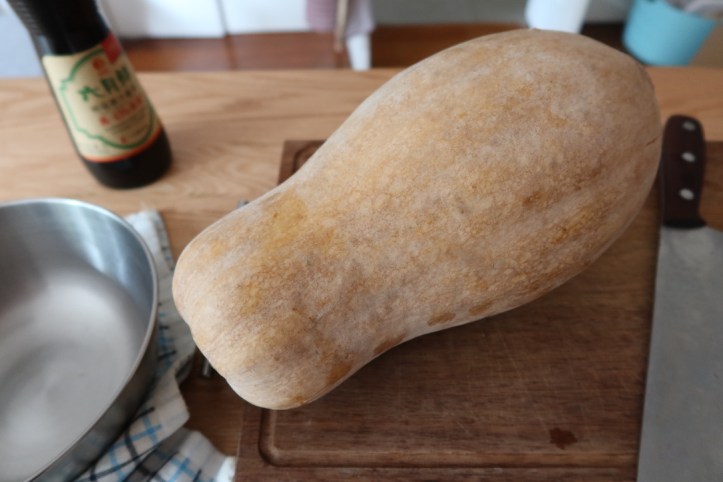
It is common in China to age harvested gourds for a few months before cutting into them. The outside might look calm enough, but it turns out there’s a whole circus of molecular activity going on inside. As my all-time favorite chemistry professor explained it:
when the woody carbohydrates (there for structural purposes in the pumpkin) break down, they release both sugars of all kinds – can be as different as maltose (cotton candy flavor) or xylose (wood sugar) – and lignin derivatives. Those are a whole plethora of things, including stuff like salicyclic acid (asprin), guaiacol (smokey flavor of oak barrels), vanillin, cinaminate, and so on. So, not only is the texture changed and softened, but flavors are released as these large chain like molecules get broken into their pieces.


Preparation was straightforward. I cut a bit off the top and hollowed out the inside using the metal handle of a soup ladle (a spoon would have worked if I had one long enough), then filled the cavity with soy sauce–two whole bottles.
If I weren’t following directions, I might also have added ginger and perilla leaves. Maybe next time.
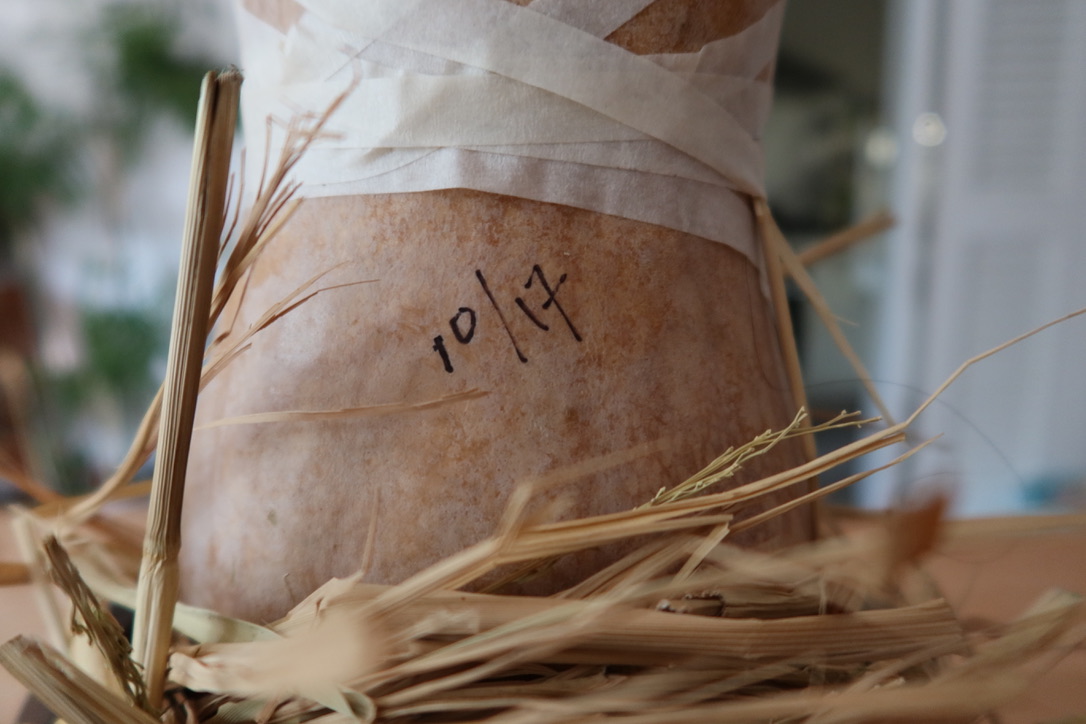
I then taped up the top, leaving me with a table centerpiece that looks like a vegetal lobotomy patient.
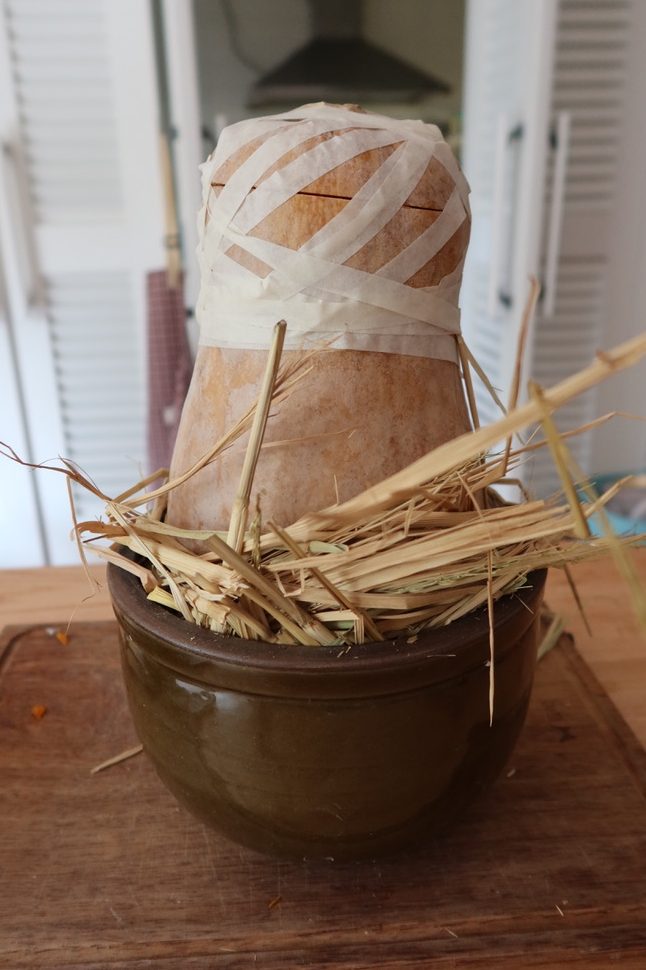
But I’m confident that the result will be worth it. The natural aging of the squash, plus half a year of soy sauce slowly permeating the flesh and evaporating out through the peel will produce a phenomenally rich array of tastes. Not ham, but apart from the name, it doesn’t try to be. A salt-cured melon will be quite a treat in its own right.
Let’s check back in six months to find out.
 Thomas David DuBois